
Your VW is, like all cars, made up of thousands of different components, all coming together to create a comfortable, fuel-efficient, safe, and convenient vehicle. And as with anything, we tend not to think about problems until they start to go wrong.
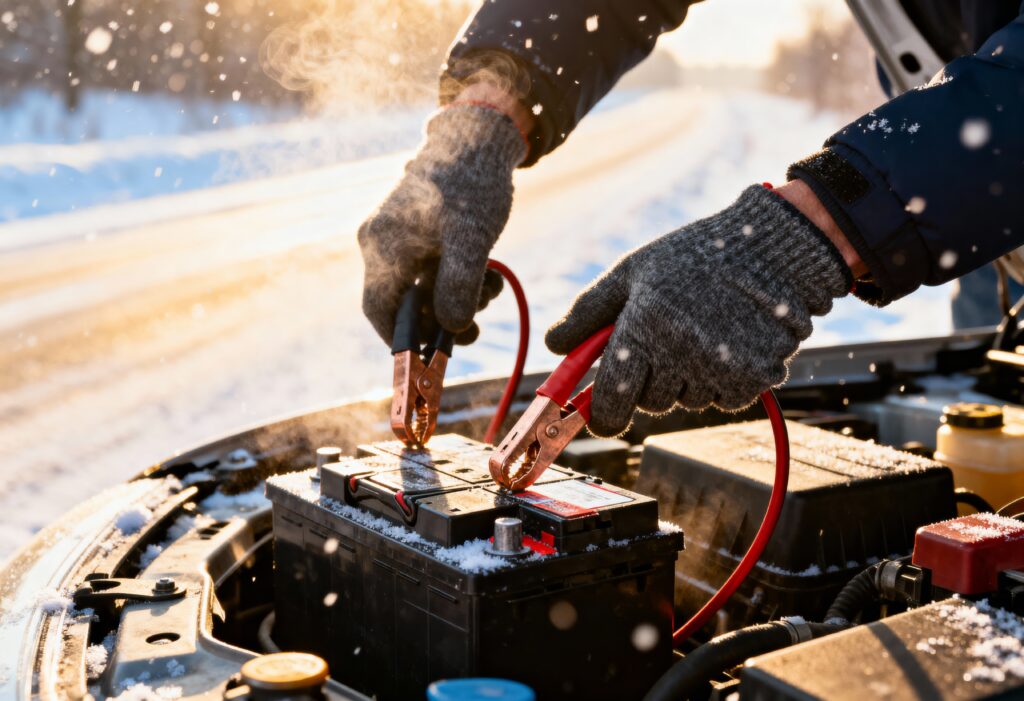
You might have noticed your VW’s battery struggling more in the cold weather of winter. That’s normal, although if you’re seeing consistent problems, take your car to a trusted local service centre in Derby, like us! On this page, we’ve put together everything you need to know about your VW’s battery and the cold.
What does my VW’s battery do?
Before looking at the impact of cold weather, let’s first establish what your VW’s battery actually does.
Car electrical systems are a bit more complex than they sometimes look. However, in simple terms, it’s fair to say that the battery’s job is predominantly to start the car and run the systems (like the alarm, central locking, dashcams, etc.) when the engine is turned off.
In the past, car owners had to start their engines by putting a handle in the front of the engine and ‘cranking’ (turning) it manually. Once the engine’s turning, the fuel ignites in the cylinders, and it continues under its own steam.
These days, we’ve replaced manual cranking with something called a starter motor. This motor has a tiny gear which juts out when you turn the key. It turns the engine (that’s the ruh-ruh-ruh sound you hear) and allows it to start.
Why is this important to know? Because the starter motor is powered by none other than the battery. So, if your battery struggles, your starter motor also struggles, and that means your car might not start.
That’s why technicians often include a battery test as part of a regular service, so it’s much easier to flag and address developing battery problems.
What battery problems do I need to watch out for in the cold?
With those basics in mind, here are a few VW battery problems to watch out for in the cold:
- Car struggles to start – as described above, the battery powers the starter motor. If it takes longer than usual to ‘crank’, the problem usually lies with the battery.
- Car doesn’t start at all – perhaps obvious to say, but if the battery’s charge level is low enough, the starter motor can’t turn at all. You’ll usually hear a little click or tap; that’s part of the mechanism that juts the little gear out. But there isn’t enough power to turn it.
- Battery warning light – if you have a battery warning light or message on your VW’s dashboard, it’s there for a reason. There’s an issue somewhere in the charging system, including the battery, as well as the alternator, etc.
- Quiet radio – the stereo system uses an awful lot of electrical energy. If you have battery problems, you might notice you need to turn the radio up louder than usual.
- Flickering or low lights – this can apply to everything, including your headlights, taillights, interior lights, even dashboard lights. Since these run on electricity, battery problems might manifest this way.
What do I need to do if I notice VW battery problems in the cold weather?
First of all, don’t panic. Battery problems are very common, especially in winter. We suggest calling and booking an appointment with your local VW specialist as soon as possible.
The technician will first conduct a few simple battery tests using specialist equipment. These show quite clearly if the fault lies with the battery (as it does in many cases) or if there’s a deeper problem.
Then, if the battery’s the issue, they’ll remove the old one and replace it with a new one. And that should be the end of your battery problems. There can, of course, be deeper issues. So, if your problems persist, return to the garage for some deeper diagnostic work.
If, however, the technician finds a deeper problem (which usually lies with either the alternator or the starter motor), your car will need some extra work.
Why does my VW’s battery struggle in winter?
If you’re interested, here’s why your VW’s battery struggles in winter.
In short, cold temperatures slow everything down, and that includes the chemical reactions inside your battery.
Your VW’s battery works by creating a chemical reaction that produces electrical energy. When the temperature drops, that reaction slows, meaning the battery can’t release energy as quickly or as efficiently as it normally would.
In very cold conditions, a healthy battery can temporarily lose a significant portion of its usable power. So, if your battery is already struggling, the cold weather amplifies those problems.
At the same time, your engine actually needs more energy to start in winter. That’s because cold oil becomes thicker (more like honey than water) and all the cold internal components get stiffer.
Basically, the cold weather means you end up with the worst of both worlds – less available power, but more power required.
Get your battery check from Sunset VW
When it comes to any work on your VW, you need to trust that it’s carried out safely, comprehensively, and at a reasonable price. Here at Sunset VW, we’ve made it our mission to serve Derby’s VW owners with friendly repair work without any of the blinding jargon.
Our team consists of locals who know VWs inside out, from our master technicians to our apprentices to our receptionists. We promise to listen to your concerns and always treat you with the respect that you deserve.
If you’re at all worried about battery problems with your VW this winter, give us a call. We’ll chat to you about your issues and get you booked in for a battery test as soon as possible. Let us help you stay safe out there.