
It’s a typical Monday morning in Derby, and the rain’s pouring down.
You’re stuck in slow-moving traffic again, and the lights only seem to turn green for a couple of seconds at a time.
It feels dull, but you’re actually busy doing quite a number of things as a VW driver. Just one of those things you’re doing is repeatedly pressing and easing off the brake pedal.
Over time, your brakes wear down, and eventually, your VW will need new brake pads. This article explains how long you should expect your VW’s brake pads to last, and what to do when it’s time for some new ones.
What your VW’s brake pads do every day
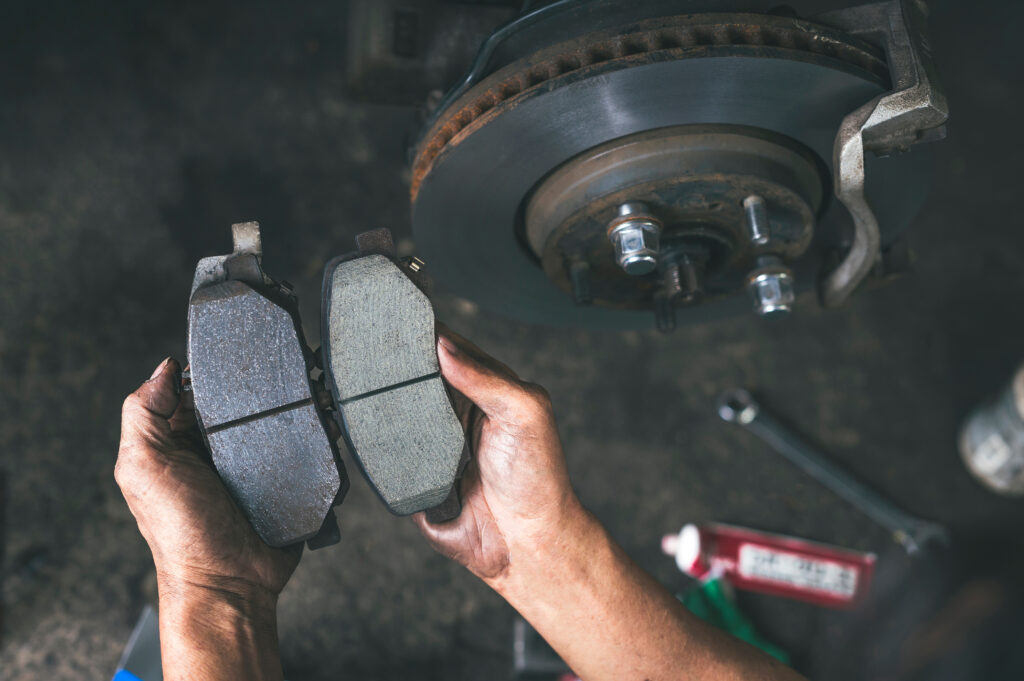
When you press the brake pedal in your car, the brake pads press against the brake discs. The brake pads have, when they’re new, about 1cm of frictional material on their faces. This frictional material presses into the face of the disc, and that’s what slows you and your car down.
Every time you press the pedal, a microscopic amount of material comes off the pad. It’s just a natural part of how friction works. It doesn’t matter if you’re driving down the A52, parking in town or stopping at the school gates, your pads wear with every stop. The harder you brake on a regular basis, the more they’ll wear.
Brake pads are consumable parts, just like tyres or windscreen wipers. They’re supposed to wear down. That’s how they work. In fact, if pads didn’t wear down, car makers would have to design the discs to take the punishment instead. Discs are more expensive, so it makes sense for the pads to handle the wear.
So, the brake pad and disc is a simple system, but one that’s vital for making your VW stop safely.
When to expect to replace your VW’s brake pads
Most brake pads last between 25,000 and 60,000 miles. We know that’s a massively varying figure. Some people might not drive those 35,000 extra miles over five years. Unfortunately, it’s very difficult to give a precise answer, because the exact figure depends on how and where you drive.
A car that spends most of its time on the motorway uses the brakes less often than one stuck in city traffic. Drivers who brake hard also wear their pads quicker than those who ease off early, as mentioned above. If you often take the country lanes instead of the M1 or the A38, you’ll probably brake more there, too, because of all the corners, T-junctions, horses and cyclists.
Brake discs, the bit that the pads press against, also wear down, although more slowly. They develop a little groove where the pads press against them. We recommend replacing the discs simultaneously with the pads to ensure they work properly.
Some people change the brake pads without replacing the discs, which means they can go through two sets of pads before needing one set of discs. The trade-off here is the potential for uneven wear and juddery or poor brake performance. It’s always worth checking with us first so we can give you clear advice before any work goes ahead.
Lots of cars don’t have brake pad sensors, especially older models. Instead, technicians check the brake pads using gauges during a service visit. They’ll recommend new ones if the thickness is below 3mm. Once the thickness drops below 1.5mm, your pads are considered unsafe for the road and are likely to fail on the MOT. The tester checks if pads are ‘dangerously worn’.
Many modern cars, including VWs, come with an automatic brake pad warning sensor. If you have one of these cars, when your brake pads get too thin, your car will display a warning light or a service reminder. Take your vehicle to a trusted garage to have new pads installed.
In the meantime, there’s one last safety layer to let you know when you need new brake pads. Manufacturers build a layer of metal into the pad. When your brake pads get dangerously low, you’ll hear a terrible screeching sound whenever you brake. That’s a sort of last resort warning, telling you to get new brake pads immediately.
Why brake pad wear is actually a good thing
Brake pads are built to wear down. That sounds odd, but it’s their purpose. Pads sacrifice themselves so that discs, callipers and wheels last longer. Brake pad wear means your brakes are working, after all. That can’t be a bad thing.
The trick is not to avoid wear altogether. You need to brake, but to manage it in a safe, cost-effective way.
You help keep costs down by driving smoothly. Anticipate traffic, ease off early and avoid heavy braking when possible. Using the engine to slow down (that is, don’t coast to a stop in neutral) also reduces the pressure on the pads. None of this removes the need to change them, but it might stretch the time between visits to the garage a little.
The bigger decision is where to go when they do need changing. Dealerships often charge more than independent specialists, but you want to know you can trust whoever you let work on your VW. Look for a trusted local garage with experience working on Volkswagen Group vehicles. Here, you’ll get the same high standard of work as dealerships, sometimes better, and usually at a lower price.
At Sunset VW in Derby, we are experts in Volkswagen, Audi, SEAT, and Škoda models. We inspect brake pads and discs during servicing, clearly explain what needs to be done, and replace parts only when necessary. So, next time you’re stuck at the lights in Derby, and you press the brake, you’ll know everything is working exactly as it should, because you’ve had it looked after properly.