
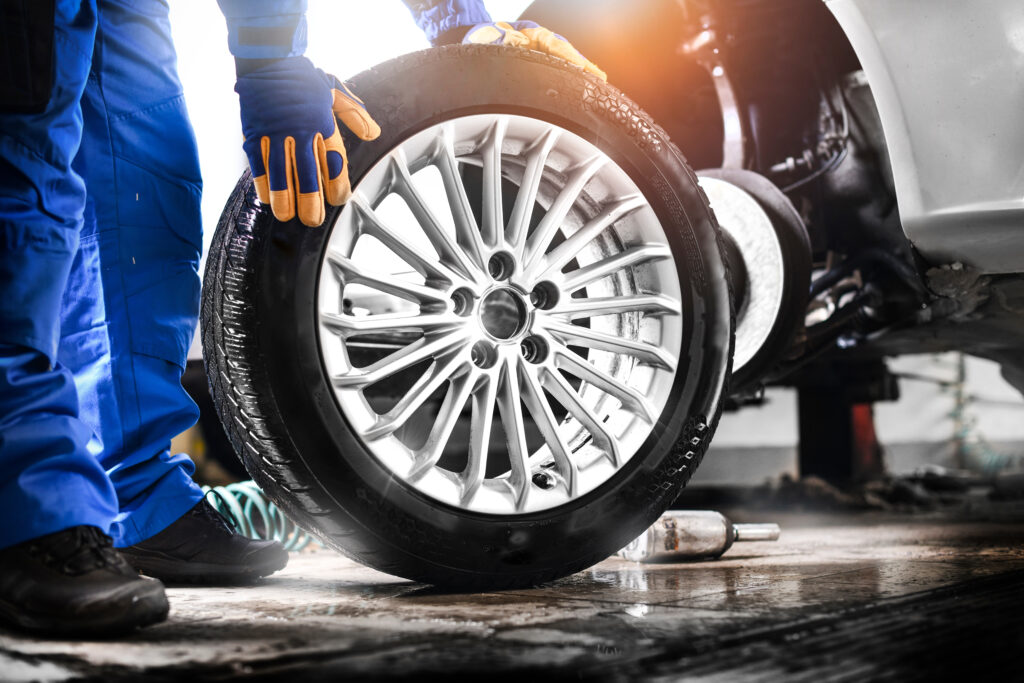
Your tyres are one of the most overlooked parts of your VW. After all, without them, a car wouldn’t be going anywhere.
Tyres are, unfortunately, quite expensive. We understand that you want to make them last as long as possible. But like all mechanical components, tyres do wear out eventually, and when they do, your car becomes extremely dangerous.
You should replace your tyres before they reach this point. This keeps you and everyone else on the road or in your car safe.
On this page, we’ve put together a quick explainer about when you should change your VW’s tyres.
Why tyres are more important than people think
Every single part in your car that makes it drive is dependent on the tyres. Without that point of contact on the road, you won’t be going anywhere at all. If your tyres can’t maintain traction with the road surface:
- Your braking distance increases
- The steering becomes imprecise
- You’re likely to skid and lose control
- Stability control doesn’t work properly
- The ride becomes incredibly uncomfortable
- You hear more road and suspension noise
- Aquaplaning becomes more likely
- And many more severe problems.
Tyres aren’t just consumables. They’re a critical drive and safety component. This is why premium tyres can be much more worthwhile than people realise (more on that later).
How to know when to replace your VW’s tyres
‘Tread depth’ refers to the depth in the tread (the grippy part of the tyre), which you can measure at home using a simple tool called a tyre tread depth gauge.
In the UK, the legal minimum tread depth is 1.6mm. If a police officer finds your tyre tread to be less than this, you’ll get a fine and possibly penalty points. Your car will also fail its MOT. However, a tyre’s performance starts to significantly drop off when the tread depth reaches around 3mm, so most mechanics and manufacturers recommend you change your tyres at this point.
For reference, most tyres come from the factory with a tread depth of around 7mm or 8mm. A typical driver in our country might expect to replace their tyres every couple of years.
Now, how fast your tyres wear down depends on all sorts of factors, including how far you drive, the road conditions, whether you live in the city, your typical commute, the type of tyre, your driving style, and more.
Do a quick visual check
Here’s a simple check you can do at home. Park up and turn your steering wheel to full lock (as far as it will turn in one direction). Then, put the handbrake on and turn the engine off. Get out of the car and do a quick visual inspection of your tyre treads.
The steering wheel being at full lock will make the tyres stick out so you can see one from behind the car and the other from the front. This is a great opportunity to check the tread depth using a tread depth gauge. Press the gauge into the tyre tread to measure its depth. If they’re at or approaching 3mm, it’s time to invest in some new ones.
At the same time, look for the following:
- Cracks (big or spider-web-like) in the sidewall
- Bulges or bubbles
- Cuts or embedded debris
- Rubber that looks dry or hardened
- Strips or patches of bare tread
These issues can weaken the tyre structure and increase the risk of sudden failure. If you notice any of these signs, it’s best to have the tyre inspected as soon as possible.
Poor grip
If your Volkswagen no longer feels as confident on the road, your tyres may be past their best.
Common symptoms include:
- The wheels spin more easily in the wet
- Longer stopping distances
- Reduced cornering confidence
- Stability control activating more often
You may only notice this on an almost-subconscious level. It can be hard to define, but if something just feels slippy or unsure, especially on corners, bends, roundabouts and in the wet, it’s valid. We always listen to all worries a customer might have with their car, no matter how vague.
If the car feels less secure than it used to, the tyres should be checked.
Pulling to one side (tracking/alignment)
If your Volkswagen pulls slightly to one side or feels like it follows grooves in the road, it’s probably due to misaligned tyres. Alignment (also known as tracking) refers to the angles at which the tyres sit relative to the road and suspension.
When the toe angle is wrong, your tyres aren’t pointing straight ahead.
Think about your feet.
If you point your toes outwards (like 11 o’clock and 1 o’clock), that’s called toe-out. When this happens on your car, the inside edges of the tyres wear down faster.
If your toes point inwards, that’s toe-in. On a car, this causes the outside edges of the tyres to wear down faster.
Poor alignment itself doesn’t mean your tyres need replacing. But if it’s been going on for a while, your tyres may have worn down below 1.6mm. And that means they do need replacing. Get a technician to check their condition.
ABS keeps coming on
The anti-lock brakes (ABS) are part of an electronic system to help you stop when your tyres lock up. It’s a sudden vibration feeling through the brake pedal when you press the brake, usually noticeable during sudden stops from higher speeds.
If you notice the ABS activating more than usual, your tyres may not be gripping the road properly. When the tread is worn down, the wheel can lock up during braking, and the ABS engages to stop the car from skidding.
There are plenty of other reasons why you may be noticing your ABS coming on more frequently, but it’s well worth checking your tyre condition.
Tyre age
Tyres are made of rubber (and other materials), and rubber wears down over time. It becomes brittle, hard and flaky.
A tyre grips the road because of its flexible structure. The rubber presses into the road and creates friction. So if your tyres lose that flexibility, they won’t grip very well at all.
A tyre’s typical maximum lifespan is around five or six years. If your tyres are this old, it’s worth replacing them, regardless of tread depth.
You can check the tyre age using the DOT code on the tyre sidewall. These four numbers show the week and year of manufacture. For example, ‘0120’ means the first week of 2020. (Which would indicate that it’s definitely time for some new tyres.)
You keep losing tyre pressure
If you need to top up air frequently, it may indicate:
- A slow puncture
- Damaged sidewall
- Cracked rubber
- Bead seal failure
Sometimes the tyre can be repaired, but often repeated pressure loss means replacement is the safer option.
You’ve hit a kerb or a pothole hard
Even if there’s no obvious damage, a heavy impact can cause internal structural damage, usually in the sidewalls. These may slowly break down as you continue to drive, leading to a bulge in the sidewall. This is a very dangerous situation and makes blowouts at high speeds much more likely.
To stay safe, have your car checked for any damage by a trusted technician.
Mismatched tyres across the same axle
There’s a reason why mechanics usually recommend changing at least two tyres at once.
It’s because if tyres across an axle (ie both front or both back tyres) are different brands, have different tread depths or even different tread patterns (never mind if they’re different sizes, which occasionally happens), it reduces grip consistency, affects braking and stability and can increase wear on the components in your car.
On many VW models, especially those with stability control and AWD systems, matched tyres are essential.
If you or a technician finds this problem, the best remedy is to get two new tyres as soon as possible. It’s expensive, yes, but it saves your car from further damage and keeps you safe.
Do front tyres wear down faster than rears?
Front tyres tend wear down more than the rears. That’s because they’re responsible for all that steering.
However, in general, ‘driven’ wheels (those to which the engine and gearbox send power) wear down faster than ‘undriven’ wheels. In a front-wheel-drive car, this applies to the front tyres. In a rear-wheel-drive car, it’s the rears.
In a four-wheel-drive vehicle, all four tyres will usually wear faster. And in an all-wheel-drive, the vehicle usually sends most power to two wheels (in most cases, the fronts); the rears only engage when extra traction is needed or when the AWD system redistributes power.
The risks of not changing your VW’s tyres when you need to
Driving on worn tyres increases risk more than you might realise. The main dangers include:
- Longer emergency stopping distances
- Reduced control in corners
- Greater chance of dangerous high-speed blowouts
- Higher risk of aquaplaning
- Significantly more wear on suspension and steering components
There are also legal and financial consequences. Driving with illegal tread depth can result in fines and penalty points. And if your tyres are deemed unsafe, it may affect an insurance claim.
So, always remember that replacing your tyres at the right time is far less costly than dealing with accident damage or major mechanical repairs.
A final note: always avoid second-hand tyres.
Just before we conclude, there’s one more thing to mention. Second-hand tyres.
You might find second-hand (that is, used) tyres for sale and available for your car. We strongly recommend that you never fit them.
Quite simply, this is because someone else has removed them from their car for some reason. And it’s probably not a good reason. You can’t rely on that tyre to perform properly. Although you might save money in the short term, it’ll be less safe and won’t last as long.
So, don’t fall into the trap. Instead, we usually recommend mid-range tyres for ordinary drivers, or premium tyres for higher-end cars. These perform much better and last longer, giving you a better (and safer) return on your investment.
Book your tyre inspection with Sunset VW in Derby
Your Volkswagen is engineered to deliver precise handling, safe braking and confident performance, but only if the tyres are in good condition. Regular checks and timely replacement keep those systems working as intended.
If you’re unsure about your tyre condition, the safest approach is to have them inspected by specialists who understand VW models and factory specifications.
That’s where we come in. Book your tyre inspection or replacement with Sunset VW today. We’ll help you understand what your tread depth, wear patterns, pressures, and alignment all mean, so you can get back on the road with confidence, knowing that you and your loved ones are as safe as possible.