
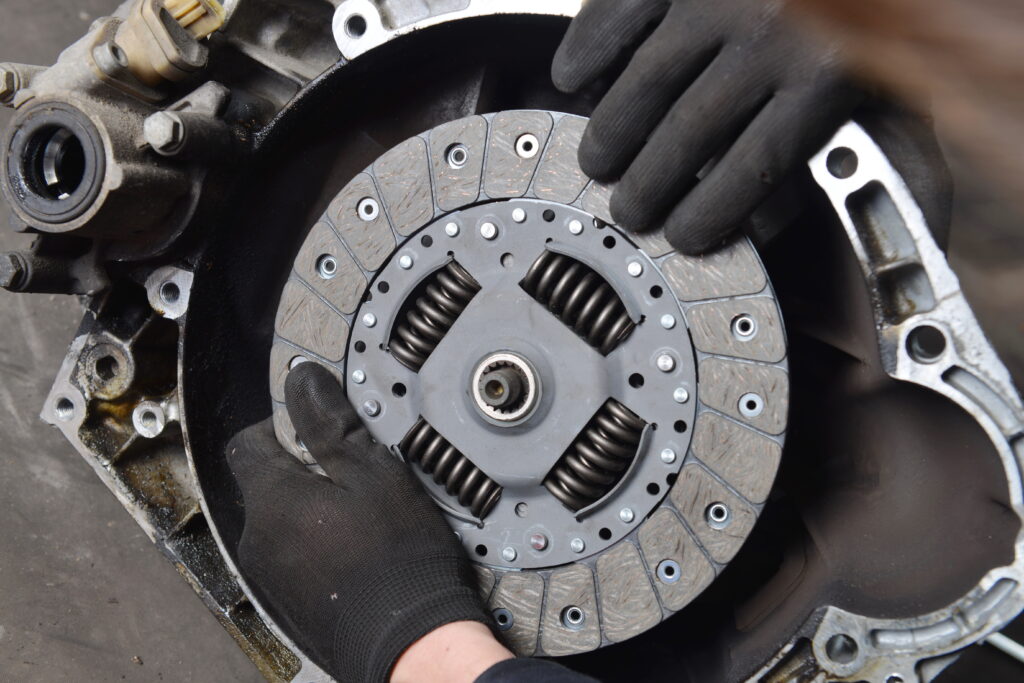
If your Volkswagen is revving higher than usual, struggling to go into gear, or not pulling as it should, the clutch is one of the first things to check out.
Clutch wear is a normal part of driving a manual VW, just like tyres or brakes. The important consideration is whether it’s normal or premature. Here are the clearest warning signs to look out for.
What does the clutch do?
First, here’s a very simple overview of how your clutch works.
In a manual Volkswagen, the clutch connects and disconnects the engine from the gearbox. This allows you to change gears without damaging the gears or shafts.
The clutch works using friction between two surfaces, a spinning plate from the engine (the flywheel) and a friction disc connected to the gearbox. When they’re pressed together, they grip and spin at the same speed, set by the engine flywheel, to transfer power to the wheels.
When you press the clutch pedal, the clutch disc’s surface separates from the engine flywheel. The flywheel spins freely while you select a gear. When you lift your foot, the clutch presses back against the flywheel, reconnecting the engine to the gearbox and, therefore, the wheels.
Over time, that friction material wears down, which is why all clutches will eventually need replacing.
Five warning signs your VW clutch is failing
Here are five of the most common warning signs that your VW’s clutch may be wearing out. If you notice any, take your car to a trusted local Volkswagen service centre. In the meantime, avoid aggressive acceleration, don’t rest your foot on the clutch, and limit your driving time if the slipping is noticeable:
Revs rise without matching acceleration (clutch slipping)
You press the accelerator pedal, but your VW doesn’t seem to accelerate properly. You’ll notice this in situations where the clutch is under higher load, such as hard acceleration, overtaking, or driving uphill. The problem could be the clutch starting to slip.
These symptoms could also represent a power problem, such as a misfire, lean engine mixture, malfunctioning ignition coils, or caked-up spark plugs.
High or changing biting point
One of the most classic signs of wear is if the clutch only engages near the top of the pedal travel. Now, some cars naturally have a high biting point. That’s fine. It’s when you notice the biting point gradually moving higher over time that it may mean the friction material is wearing thin.
Burning smell when driving
A burning clutch is a unique smell. If you smell acrid, chemical heat, like burning rubber, especially in city or motorway traffic or during hill starts, it means your clutch is overheating. That smell comes from the friction material getting too hot. Clutches can overheat occasionally, especially if you’re stuck in heavy traffic on a hill. That’s okay. But if it happens on a regular basis, don’t ignore it.
Difficulty selecting gears
You may eventually find it harder to select certain gears, especially lower gears like first, reverse and possibly second. You might feel resistance or grinding when you select the gear, and need to force it into place.
This can also be caused by gearbox or linkage issues, but if you notice it alongside other symptoms listed here, clutch wear is a plausible root cause.
Clutch pedal feels different
When the feel of your clutch pedal changes over time, it might be easy to miss. Think back, though. Was your clutch pedal always this spongy or soft? Is it now unusually stiff? Can you feel vibrations through the pedal? All these symptoms represent a worn clutch. If they changed gradually, the issue is probably wear. If they changed suddenly, there’s probably a hydraulic issue.
Is it safe to drive with a failing clutch?
It’s best to repair a failing clutch as soon as possible. It may still be safe to drive for a short time, but don’t let that make it seem less important to fix. Your clutch won’t repair itself. Once it starts to fail, it will continue to get worse until it eventually fails completely.
If your clutch is slipping only mildly, you may still be able to drive normally for a little while. More severe slipping or difficulty selecting gears increases the risk of losing drive altogether, which can be very dangerous, especially on hills.
In short, if you notice any symptoms of a failing clutch, take your car to a VW service centre as soon as possible.
How long should a VW clutch last?
A clutch isn’t a lifetime component for most vehicles. In most Volkswagen models, a clutch will typically last between 60,000 and 100,000 miles. Most clutch wear comes down to normal use over time. That’s to be expected. It’s nothing you’ve done wrong, just like brakes.
It’ll deteriorate sooner if you do a lot of stop-start driving in traffic, towing, or hill starts, or by riding the clutch. You can extend your clutch’s lifespan with smooth gear changes, minimal clutch slip and if you happen to do more motorway than city driving.
Some drivers are lucky and get well beyond 100,000 miles. Others may need a replacement much sooner.
How much does a VW clutch replacement cost?
Here in the UK, a typical replacement Volkswagen clutch might cost between £500 and £1,200. The specific cost depends on your model, the listed labour time, the garage you use, and whether your car also needs a new flywheel. Flywheels generally last longer than clutches, but on higher-mileage vehicles they can wear or become damaged. This naturally increases the repair costs, often by quite a lot, unfortunately.
Have Sunset VW in Derby inspect your clutch
If you notice any symptoms of your clutch slipping in Derby, we can help. Sunset VW is your local Volkswagen specialist service centre. Our team knows your car inside out, and we’ll diagnose the problem and get it fixed, whether it’s the clutch or something else.
We always guarantee a friendly face and a warm welcome. Don’t be afraid to bring your car to us. We’ll always treat you (and your vehicle) with the respect you deserve. Give us a call today if you’re at all worried about your clutch, and we’ll get you booked in as soon as possible.